

Two Labs, One Team: A Chemoenzymatic Story
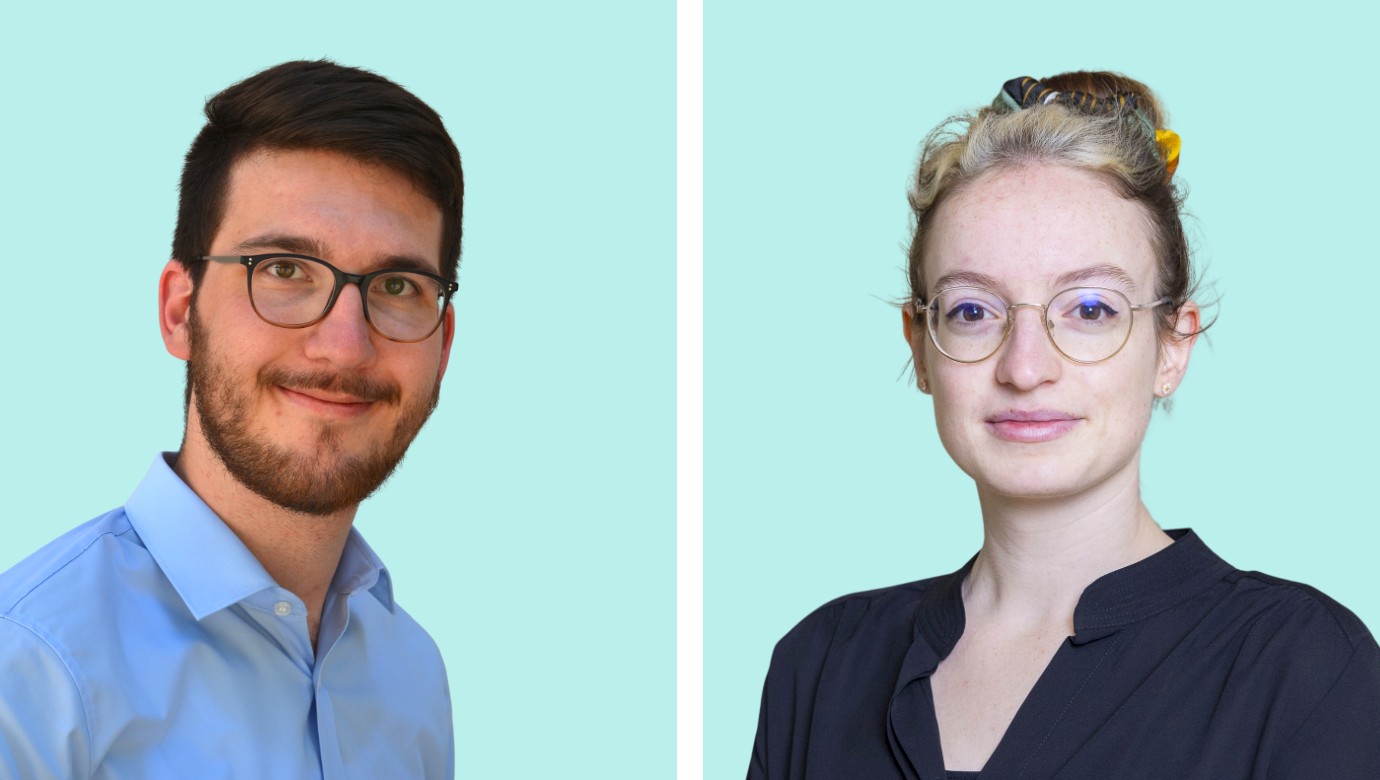
Team portrait, from left to right: Nicolas Imstepf, Adriana Neves Vieira.
At the end of 2025, two researchers from ZHAW and ETH Zürich participated in a lab exchange, where they each spent time in the other's lab, working together on their joint project through the NCCR Catalysis Catalyzer Program. Meet Adriana Neves Vieira, a recipient of the 2025 Talent Program in Catalysis and Sustainable Chemistry, and Nicolas Impstef, a recipient of the 2022 NCCR Catalysis Young Talents Fellowship, as they describe their experience!
Hi Adriana and Nicolas, could you tell us about yourselves and your research within NCCR Catalysis?
Adriana: I come from Portugal and grew up in Neuchâtel. I then moved to Lausanne, where I completed my Bachelor’s and Master’s degrees in Molecular and Biological Chemistry at EPFL. I continued my training by joining the Morandi group as a PhD student to develop new catalytic methods for organic synthesis. I have been collaborating with Nicolas and Prof. Buller to develop a cooperative chemoenzymatic system. In parallel, I also focus my research on developing new uses for phosphonium salts.
Nicolas: I grew up in a small village in the canton of Valais and started my career with an apprenticeship as a chemical laboratory technician at Lonza. I subsequently earned a Bachelor’s degree in Chemistry and a Master’s degree in Computational Life Sciences from the ZHAW. Since 2023, I have been a PhD student in the Buller group, where I focus on engineering enzymes for next-generation industrial biocatalysis. In our collaborative chemoenzymatic project, Adriana leads the chemical aspects, while I contribute specialized expertise in biocatalysis and enzyme engineering.
How did the collaboration between the Morandi and Buller groups emerge?
Adriana & Nicolas: The collaboration began during the preparation of Phase II of the NCCR Catalysis, when Prof. Buller and Prof. Morandi jointly proposed the project's core idea. At the same time, Adriana began her PhD in the Morandi group and expressed interest in a collaborative project that aligned well with the Phase II timeline. This led to a joint brainstorming session involving all four researchers, during which the project took shape and evolved into its current form.
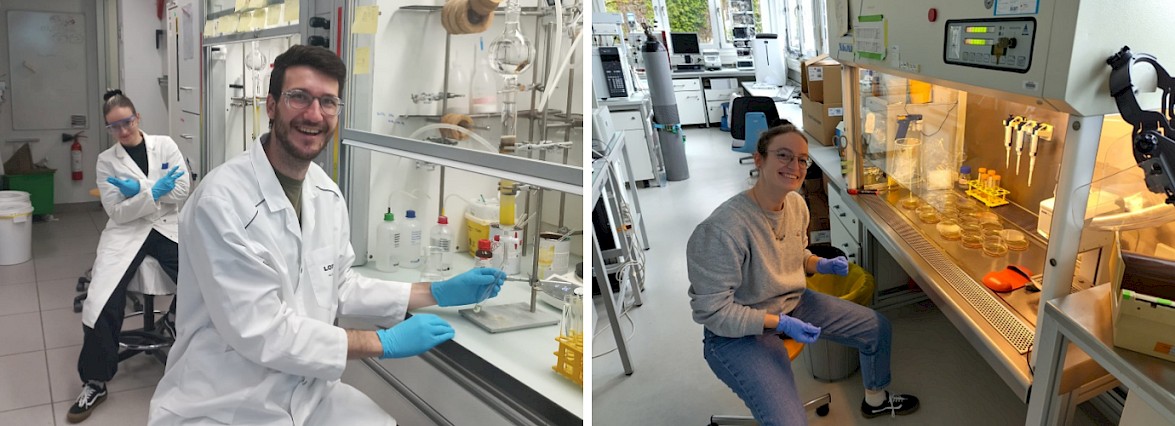
Adriana and Nicolas in the Morandi lab at ETHZ (left), and Adriana in the Buller lab at ZHAW (right).
You recently conducted a tandem lab exchange between ZHAW and ETH Zürich. How did the exchange benefit you as researchers and impact the project?
Adriana: It has been an amazing opportunity for me to practice interdisciplinary collaboration. This reflects what happens in industry, where I am heading, where most projects include members with very diverse backgrounds. I could develop my leadership and communication skills as well as my understanding of biochemical lab work.
Nicolas: The collaboration exposed me to a different academic culture and strengthened my critical thinking by encouraging me to approach problems from new perspectives. A decade after completing my apprenticeship, the exchange also served as a valuable refresher in organic chemistry and provided deeper insight into advanced experimental techniques.
Adriana & Nicolas: At the beginning of the collaboration, we faced natural challenges: the partner lab’s organization and workflows were unfamiliar, with different methods and corresponding problems. This lack of shared context made it difficult to contribute ideas that were both relevant and technically feasible. Without a clear understanding of how their research was conducted, even well-intentioned input risked being impractical or misaligned.
Through developing a deeper understanding of our partners’ work and maintaining open, continuous communication, we were able to anticipate challenges early, align expectations, and collaboratively develop effective solutions rather than simply merging results. Daily exchanges during these weeks enabled efficient idea sharing, faster progress, and a shared perspective on the project, ultimately strengthening both its direction and the quality of the research.
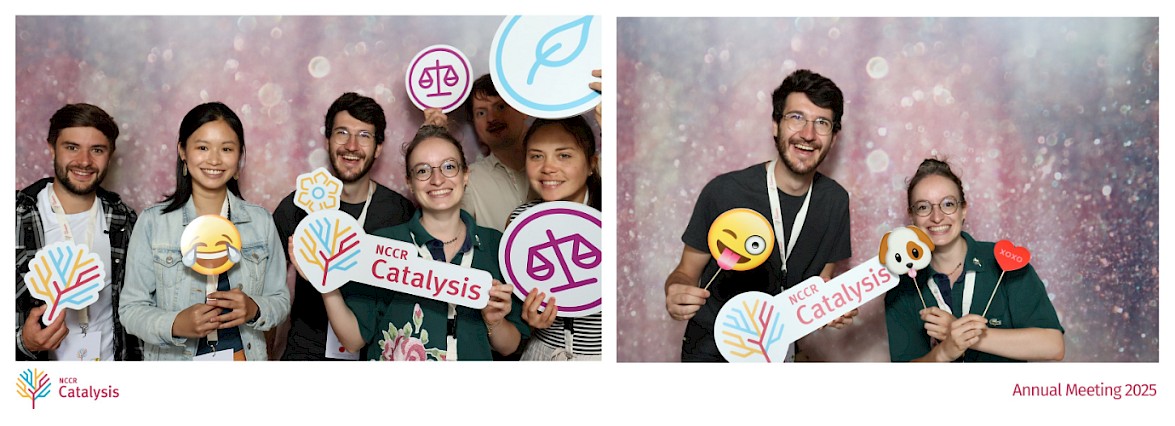
Adriana and Nicolas with NCCR Catalysis colleagues from the Buller and Benin groups at the photo booth at the NCCR Catalysis Annal Meeting 2025.
What advice would you give other early-career researchers on collaborations and exchanges between labs?
Adriana & Nicolas: Take the opportunity to visit other laboratories! You learn about a new field from passionate researchers, and you can share your own passion with someone eager to learn. In addition, you will also gain more insight into your own field, since your collaborator will ask questions about information that you took for granted.
What did you learn from hosting your colleague in your lab?
Adriana & Nicolas: It made us aware of different working styles. The colleague's arrival burst the scientific bubble we had been in, since we had quickly gotten used to our own laboratory's working habits. We got a different perspective that helped us realise what we had overlooked as good organizational features. It also made us aware of areas that could be improved, to make our PhD stay better and healthier.
What was surprising about your experience in the other lab?
Adriana: I had the misconception that enzymes are fragile at temperatures far from 37°C and in the presence of water as a solvent. I was surprised to learn that they can be used in so many different conditions and for many different substrates. I was impressed by the high-throughput methods used in biocatalysis and, as a consequence, by the amount of data that bioinformaticians need to handle.
Nicolas: One of the most surprising aspects of my experience in the Morandi lab was the versatility of the research areas and the level of independence given to researchers. PhD students were encouraged to choose and shape their own research projects, fostering a strong sense of ownership and motivation. This combination of diversity and independence made the lab environment both empowering and inspiring.
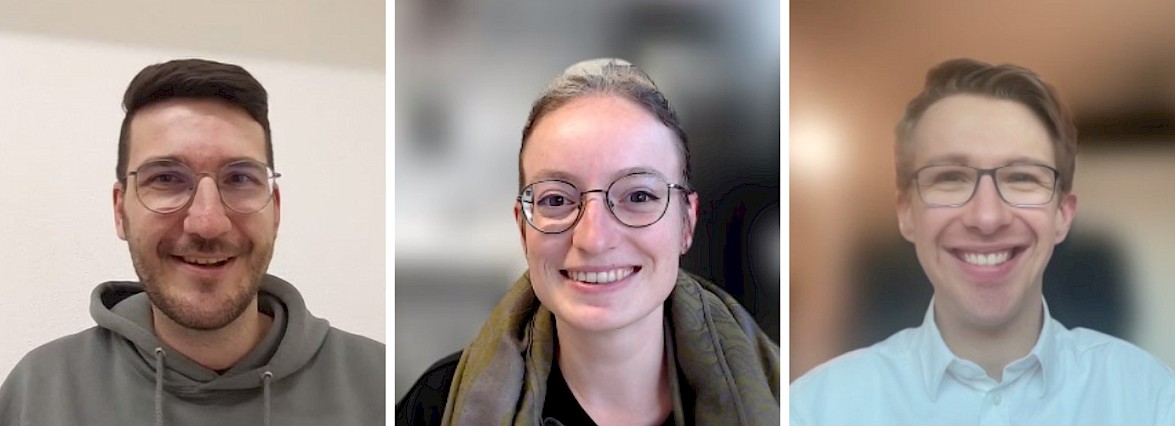
Nicolas, Adriana and Stefan in a Zoom call between the Buller, Morandi and Jorner groups.
What will be the next steps in your collaboration?
Adriana & Nicolas: To accelerate the identification of a functional system, we expanded our collaboration to include Stefan Schmid, another member of NCCR Catalysis (Jorner group), who brings expertise in computational chemistry. His work employs Bayesian optimization to guide reaction optimization and efficiently steer the system toward product formation. In parallel, we are extending the developed model system to more complex substrates such as hormones.
Thank you so much for sharing your experience! We wish you continued success in your project.
Learn more about Adriana's research here, and connect with her on LinkedIn. Learn more about Nicolas' research here, and connect with him on LinkedIn.
 tweet
tweet